Misconceptions
There is a common misconception that Type 1 Diabetes is only diagnosed at birth, or from a very young age. In reality, 62% of T1D diagnoses occur over the age of 20 (Gregory et al., 2022).
This myth stems from the use of the outdated term “juvenile diabetes” , which suggests that T1D exclusively affects young individuals.
The Reality
A study was carried out to characterise the age distribution of 947 adults diagnosed with Type 1 Diabetes. Figure 1, taken from Fang et al., 2023, illustrates the age at diagnosis vs the percentage incidence:
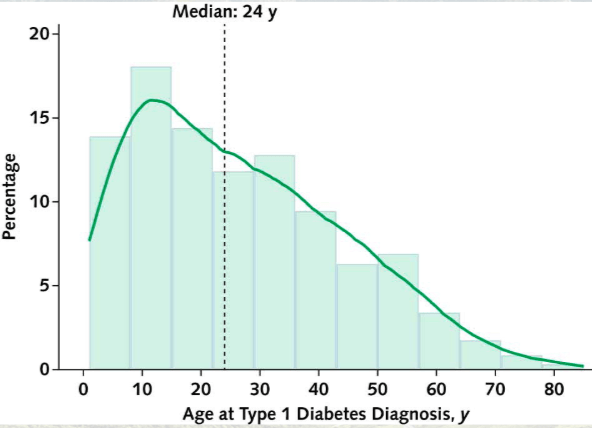
The majority of diagnoses happen around age 15, with 24 being the median age. Anyone can be diagnosed with T1D well into their 20’s, 30’s, 40’s and beyond. Indeed, 40% of adults diagnosed with T1D were over the age of 30.
The Barriers to Diagnosis
This mismatch between misconceptions and reality means that many cases of Type 1 Diabetes go unnoticed or are misdiagnosed, increasing the risk of Diabetic Ketoacidosis (DKA), a life threatening complication of Type 1 Diabetes.
The symptoms and indicators of T1D, such as tiredness and weight loss, can be mild and have a more gradual onset in adults, often leading to dismissal.
In adults, high blood sugar levels can also be mistaken for Type 2 Diabetes (T2D). This can lead to worsening symptoms without proper medication and a delayed diagnosis of T1D and insulin therapy. Based on anecdotal evidence, this is a common occurrence for adults diagnosed with T1D later in life.
How Are Adults Diagnosed?
When individual presents with DKA, the diagnosis is likely to be T1D as this condition arises due to complete insulin deficiency.
For those experiencing symptoms and high blood sugar, but not in DKA – autoantibody and C-peptide testing are recommended to determine the type of diabetes suspected.
However, there are more than two types of diabetes! Latent autoimmune diabetes of adulthood (LADA) is often misdiagnosed and falls somewhere in between T1D and T2D (Appel et al., 2009).
Stay on your toes!
Anyone can be diagnosed with T1D at any age. Any symptoms of T1D should be investigated seriously and thoroughly regardless of age. These include the 4 T’s: Thirsty, Thinner, Tired, Toilet.
Thank you very much for reading,
Lydia x
References
Gregory, G.A., Robinson, T.I., Linklater, S.E., Wang, F., Colagiuri, S., de Beaufort, C., Donaghue, K.C., Harding, J.L., Wander, P.L., Zhang, X. and Li, X., 2022. Global incidence, prevalence, and mortality of type 1 diabetes in 2021 with projection to 2040: a modelling study. The lancet Diabetes & endocrinology, 10(10), pp.741-760.
Fang, M., Wang, D., Echouffo-Tcheugui, J.B. and Selvin, E., 2023. Age at Diagnosis in US Adults With Type 1 Diabetes. Annals of Internal Medicine, 176(11), pp.1567-1568.
Appel, S.J., Wadas, T.M., Rosenthal, R.S. and Ovalle, F., 2009. Latent autoimmune diabetes of adulthood (LADA): an often misdiagnosed type of diabetes mellitus. Journal of the American Association of Nurse Practitioners, 21(3), pp.156-159.
This is purely informational and not intended as medical advice, read my disclaimer here.
 LYD1A KERR
Leave a comment