We’re all well aware that exercise has many benefits for physical & mental health. The benefits for managing type 1 diabetes are no exception. So why do our own blood glucose levels (bgl’s) make it so difficult to exercise? Isn’t it ironic that exercise can increase our blood sugars, but also make them drop so we have to pause our sweaty gym session to eat sweets? In this blog I’m going to discuss how exercise impacts our levels and give insight into how you can manage type 1 diabetes and exercise. Spoiler alert, it involves planning.
I promise exercise really is good for type 1 diabetes
When you are constantly managing T1D, it’s sometimes nice to know that you can engage in activities that can make your life that little tiny bit easier. For me, its regular exercise in the form of two or three gym sessions a week, and lots of walking & exploring outdoors when I can.
The benefits for T1D specifically help to make this even more appealing:
- Increased insulin sensitivity – which means your body is likely to be more receptive to the insulin that you are injecting. You can perhaps get away with shorter pre-bolusing time (yay for eating food sooner!), or see less of a glucose spike when you do eat (yay for no rollercoaster!).
- The muscles can take one for the team and increase their intake of glucose. This is probably the main reason your blood glucose level can drop during exercise – the sugar is being actively taken up by your muscles instead. The good news is that this can continue after the bout of exercise & increase your insulin sensitivity.
- It’s good for your heart. We’ve all heard of the complications T1D can cause, so why not get moving to help our cardiovascular system out?
- It’s good for your head. Being in a healthy mental state of mind is so important when dealing with a chronic illness as its so easy to get in a spiral when you think about it too much. Exercise releases those beautiful endorphins and makes us feel goood. This helps the heavy load that T1D brings feel a bit lighter.
Different types of exercise & their impacts on blood glucose levels
Exercise can generally have three directional impacts on our blood glucose levels: increase, decrease, and/or stay the same.
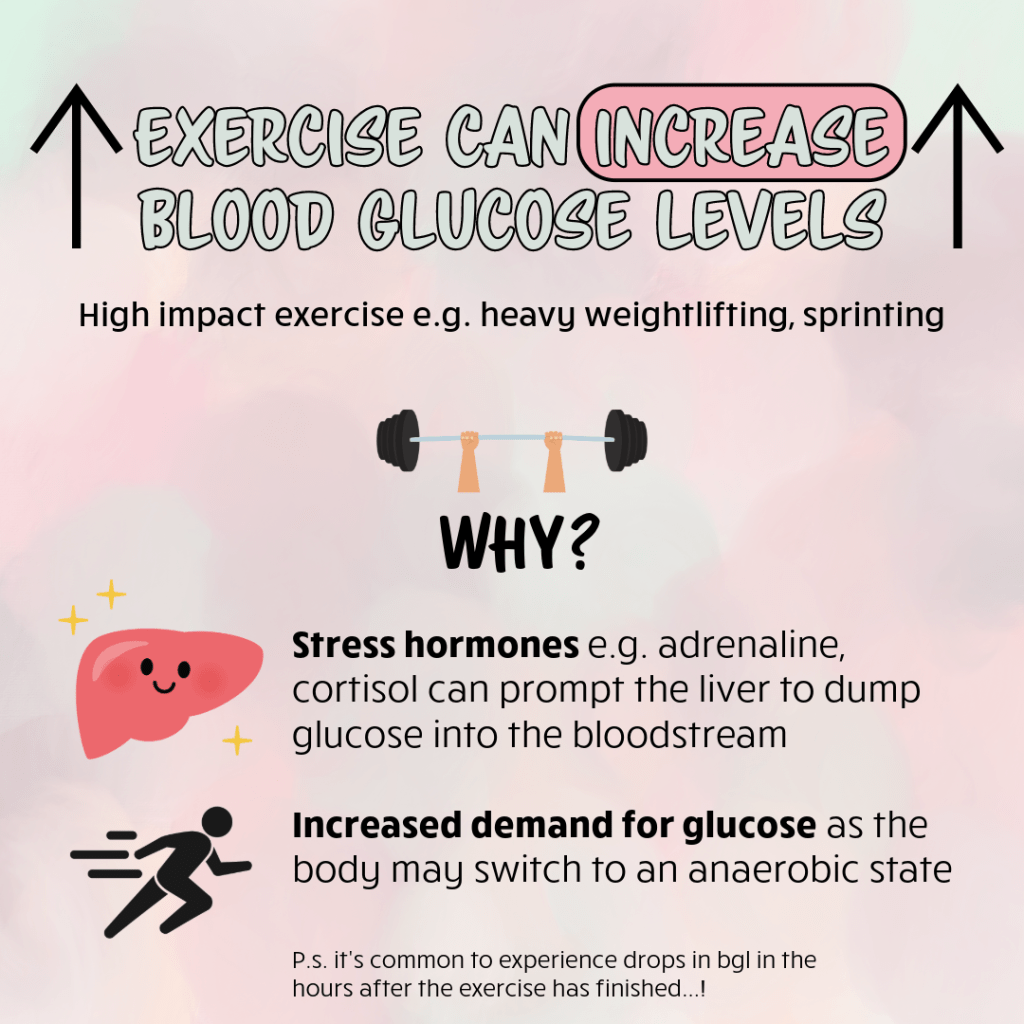
Increase in blood glucose levels?!
High impact exercises such as heavy weightlifting and sprinting can actually lead to an increase in bgl’s. I know this doesn’t sound logical, at all, but there is some interesting biology behind why this can happen:
- You’ve stressed your body out! Similar to stress caused by heavy workloads, heavy lifting can cause your body to release the stress hormones which can cause your bgl’s to spike. The main culprits are adrenaline and cortisol, which can prompt the liver to dump some lovely glucose into the bloodstream.
- You’re running out of oxygen! Okay, not really, but your body can switch to an anaerobic state during high intensity exercise, which means it doesn’t rely so much on oxygen stores. Instead, it increases demand for glucose stores, which can contribute to a rise in bgl’s.
- It’s just the way you are ❤
The good, or bad, news, depending on how you prepare, is that in the hours after the high intensity exercise you may notice your levels dropping more than usual. Usually I deal with this by reducing my insulin accordingly, or to eat more carbs.
It’s important to mention that the benefits conferred from exercise definitely overrule this temporary increase in bgl’s. You got to put your muscular & cardiovascular health first sometimes guys!!

Decrease in blood glucose levels
Exercise can lead to your bgl’s dropping, sometimes gradually, and sometimes rapidly. Sounds a bit more familiar and logical now, right? These types of exercise are generally lower impact, maybe over a longer time period, and can include jogging, swimming, cycling. Of course there are there team sports and interval training which probably increase & decrease your bgl’s, but I’m not the expert to talk on that, at all..
Instead, here are some reasons why your blood sugars can drop:
- You have insulin in your system! Well duhhh, don’t we all? Of course, but the way that type 1 diabetics inject insulin over various time points of the day is very different to non diabetics because they have a working pancreas. Instead, the timing & planning of insulin doses for type 1 diabetics is key. For example, you’ve just had your usual lunch & insulin dose, but its a beautiful day to go for a run. So off you spontaneously trot, with your phone & glucose tabs in hand. But you’re not even 15 minutes into your run and you can feel yourself start to go low, and the arrow on your cgm is there to prove it. The most likely scenario here is that you have too much insulin on board, and should have either reduced your dose or ate more carbs. Unfortunately, planning for exercise is a harsh reality we all as T1D’s have to accept sooner or later.
- Your muscles took taking one for the team too far. Earlier we discussed how your muscles can take in glucose as their energy source and lower your bgl’s. Unfortunately during exercise they just have to take it that one step further and make your bgl’s dip into the hypo zone. So greedy.
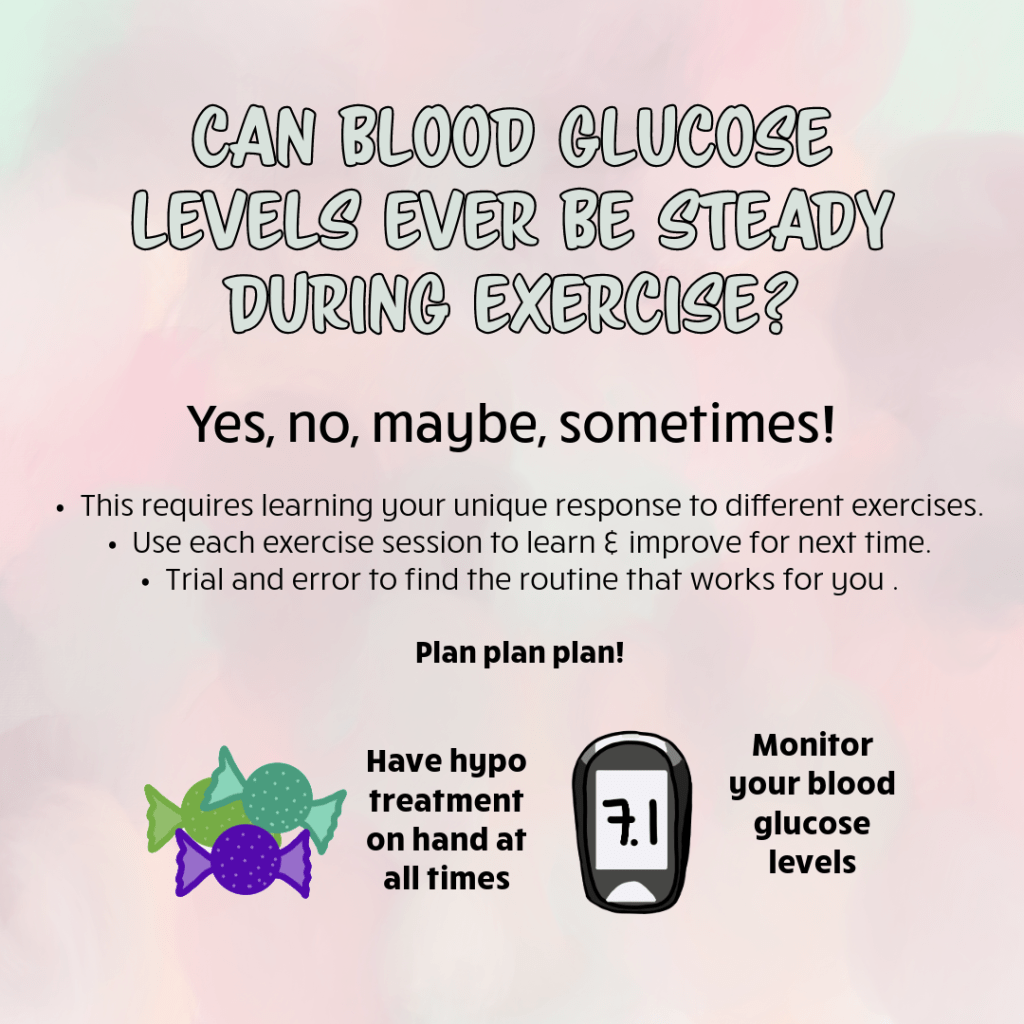
Can they really stay the same?!
Yes and no. Anyone with T1D and a blood glucose sensor (dexcom, libre) knows that your blood glucose level can never truly stay the same, but steady is a term that we like to use instead. And indeed, some forms of exercise can hold our levels nice and steady, especially walking.
However, would you believe me if I said all exercise could result in steady blood glucose level? I’ve laughed to myself writing this becuase it feels like such a rare occasion, but it really can happen.
This comes down to that all important word – planning.
If you know you are going to the gym and your bgl’s always spike – plan for it. Find what works for you. Maybe this is a dose of insulin & preventative glucose tabs. Maybe its starting out with some aerobic exercise before the heavy lifting.
If you know you are going for a run and your bgl’s always drop – plan for it. Maybe you need to reduce your insulin, maybe you need to eat more carbs, or maybe you just accept this will happen and be armed with lots of glucose gels to consume along your route.
I know its rubbish not being able to be completely spontaneous, but if you have a plan in place, maybe some spontaneity can prevail! Even if this is because you have ingrained your planning into who you are as a person.
Nonetheless, diabetes looooves to throw spanners in the works, so please don’t get disheartened when your plan only actually works 7 times out of 10. Thanks to the joy of the other 41 factors that can affect your bgl! Of course you only have to plan for activity type, duration, carbohydrate intake, insulin intake, hormones, the side of the bed you woke up on, the wind direction, etc etc. Wee buns!
You got this!
Exercising with type 1 diabetes can be really daunting. Especially when there are so many factors to take into consideration. My final piece of advice is to plan, plan, plan. Trial and error is your best friend here, you’ve just got to get out there, try some exercise, then take note of what happened to your level. Write down as many important factors you can think of that might have contributed towards what happened. And good luck! You’re trying your best and that’s all you can do.
Thank you so much for reading, hope you enjoyed it as much as I did writing it.
Lydia x
Disclaimer: everything you read is my own experience and in no way medical advice, please consult your licensed health care provider.

 LYD1A KERR
Leave a reply to Running Diaries with T1D – Lydia Kerr Cancel reply