
While heading to the airport should be an exciting time, hauling a load of medical supplies can add a bit of anxiety to the experience.
From international flights, to many domestic flights (especially while living in England and visiting home in Northern Ireland), I’ve come across a wide variety of strange airport security encounters.
My favourite memories include: one security man wanting to confiscate my spare insulin pump before an international flight, another security man requesting all of my diabetes supplies to be placed in liquids bags, and four security men all trying to put me through the full body scanner because “people with pacemakers can go through, why can’t you?” …
Despite that, I’ve made it through every time, and you can too!

First of all, I want to clarify the different airport security scanners that you might come across. Personally, I used to get so confused between the different types, especially during the rush of it all.
Airport Security
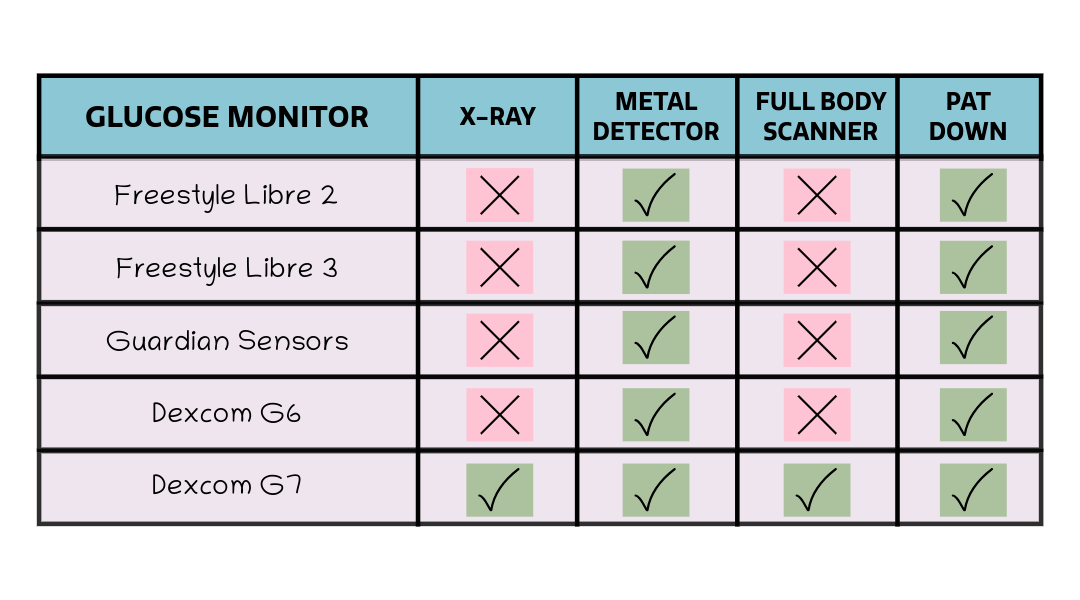
Airport security can include X-ray baggage scanners, metal detectors, full body scanners, and the traditional pat downs. I’ve gone through each glucose monitor manufacturer’s website, and Table 1 highlights whether or not it is safe to go through each security measure with your glucose monitor.
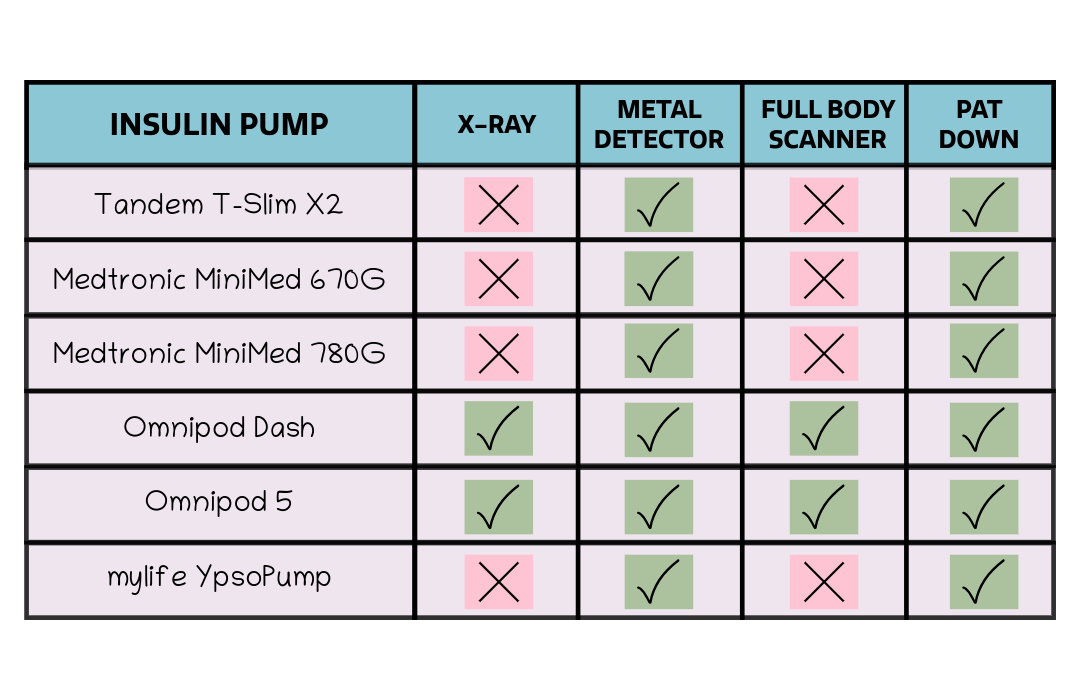
I’ve also gone through each insulin pump manufacturer’s website, and Table 2 highlights whether or not it is safe to go through each security measure with your insulin pump.
If you wish for more clarification on each security process, please read on. I have also included a step-by-step walk through of what generally happens at airport security.
X-ray baggage scanners
All of your bags go into plastic trays and are sent on a conveyor belt through the X-ray machine. If something in your bag has been flagged up in the scan, the bag will be pulled aside, and the security guard will wait for you before they search it in your presence.
X-Ray and diabetes technology
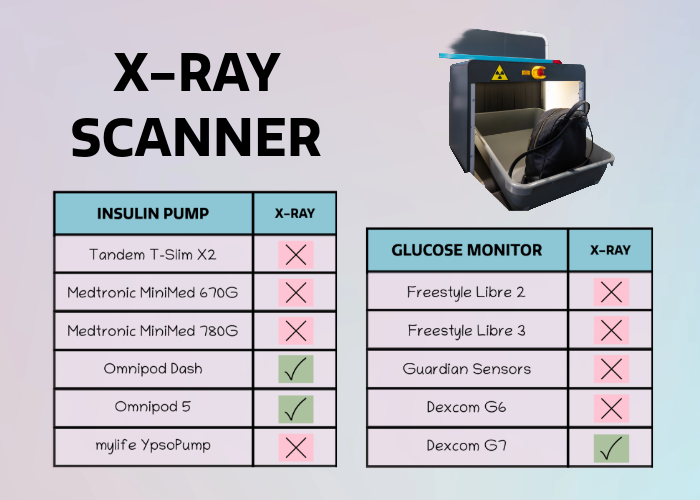
It is not advisable to place tubed insulin pumps, like the Tandem T-Slim X2, Medtronic, or Ypsomed, through the X-ray machines. However, the Omnipod is fine to go through X-ray machines.
Continuous glucose monitors, like Dexcom G6, Guardian sensors, and Freestyle Libre 2, should not go through the X-ray machine either. Instead, you should ask the airport security guards to inspect your spare sensors by hand. However, the more recently released Dexcom G7 can go through X-ray machines.
Of course, there are various accounts you’ve probably read online, who have sent their diabetes technology through the X-ray baggage scanners, and had ‘no problems’. I personally don’t want to risk anything before a trip away, and would rather follow the manufacturers instructions.
General diabetes supplies, such as needles, blood sugar meters, and insulin pump consumables, are fine to go through X-ray. Often, the security will ask you to remove these from your bag, so it helps to have it all in one place.
For insulin, airports may request that any liquid medication goes into a clear plastic bag before it goes through the X-ray scanner. It is advisable to bring along your prescription, or original packaging with the dispensing label from the pharmacy.
I’m guilty of rarely keeping my insulin in it’s regular packaging, and haven’t had any problems. My only exception has been travelling to Australia, as the government requests all medication remain in it’s original packaging.
It’s important to research the airport rules around medication from both your departure and arrival destinations.
Full body scanners
Full body scanners require you to stand on two yellow feet and to put your arms above your head so a full body scan can take place. These can involve millimetre wave or X-ray technology.
Full body scanners and diabetes technology
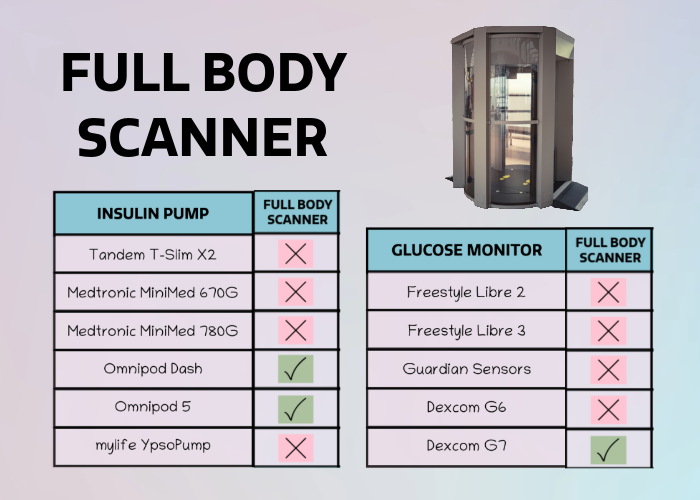
As their effects have not been studied by many of the manufacturers, it is not advised to go through full body scanners with insulin pumps like Tandem, Medtronic, or Ypsomed, or with glucose monitors like Freestyle Libre, Guardian sensors, or Dexcom G6.
Instead, you need to tell the airport security guards that you are wearing diabetes devices, and that the manufacturers do not recommend that their technology is put through full body scanners.
Currently, Omnipod’s, and Dexcom G7’s, are the exception to this rule, as the manufacturers have declared the full body scanners safe to use with this technology.
Metal detectors
Metal detectors are often available to walk through in airport security. These don’t use any X-ray technology, and only detect metal (shock!). They are a simple arch you can just walk through, often beside the full body scanners.
Metal detectors and diabetes technology
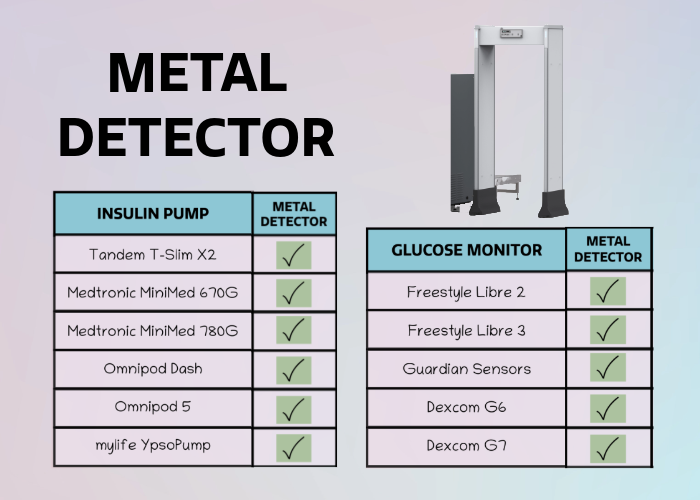
Metal detectors are safe for all diabetes technology, including insulin pumps and glucose monitors. As you walk through these, the alarm will go off, and you will be inspected by a security guard by a pat down.
Traditional pat down/frisk search
You can opt out of going through any body scanner, and can ask for a traditional pat down instead. This involves a security guard giving you a pat down, or frisk search. They can also use a metal detector wand over your body, which should generally be a metal detector. If they feel your sensor under your clothes, they may ask to see the sensor. I advise wearing loose clothing, because I’ve been in the awkward position of wearing too-tight clothing, and having to contort myself to show the sensor.
Pat downs and diabetes technology

Often the security guard carrying out the pat down will ask you to touch your pump, and then they will swab your hands, and carry out their tests.
By opting for a pat down, you aren’t subjecting your devices to any X-rays, or full body scanners, and is the safest option to keep your diabetes technology working as they should.
A step-by-step walk through airport security
Here is a general guide for how you would navigate airport security, while wearing diabetes devices which are not compatible with X-ray or full body scanners.
- When you arrive at security, you are asked to place your bags into trays which are then sent through an x-ray machine.
- You then tell the security guards that you have diabetes supplies in your bags. They may ask you to remove these from your bag, and so it is handy to keep all of your supplies in one place. Ask for your glucose monitors to be hand checked and not put through the X-Ray.
- If they are bothered, they may ask more questions. This is where it may come in handy to have a travel letter or a prescription.
- Once your bags are through the scanner, you join the queue of people to go through the body search area. Once at the front of the queue, you can tell the security guard that you are wearing an insulin pump, or a glucose monitor, and you would like to go through the metal detector.
- They should agree, and let you skip the full body scanner.
- You can then walk through the metal detector with your insulin pump and glucose monitor attached to yourself, and you will set off the alarm in the metal detector.
- This prompts a traditional pat down, or frisk search, by a security guard. They will give you a full body pat down, and may ask you to remove your shoes.
- It may be a good idea to tell them where your infusion site is, so that they can be gentle, and not accidentally rip it out.
- They will most likely ask you to touch your pump, then swab your hands. Once this swab is cleared, you will be able to collect your shoes, and your bags, and be on your merry way!
My Top Tips For Navigating Airport Security With T1D
- Have all of your diabetes supples in your hand luggage, also known as carry on luggage.
- Having a specific bag for all of your diabetes supplies is handy to keep everything in one place.
- Never put insulin in your hold suitcase – it can freeze or get lost.
- Tell the airport security guards that you are carrying diabetes supplies, and they will advise you on their specific protocols.
- Bring a letter from a medical professional, outlining your condition, the treatment you need, technology you use, and whether or not you or your supplies can go through full body scanners or X-rays. Read more about travel letters here.
- Opt for a pat down if you have an insulin pump or glucose monitor which is not compatible with the full body scanners. You can still go through the metal detector.
- Don’t panic if you accidentally go through the full body scanner – it might be okay, the technology just hasn’t been thoroughly tested by the manufacturers.
- But also, keep an eye on your blood sugar levels, and bring a back up supply of insulin pens, needles, and a blood glucose meter, just in case.
- On that note, bring a back up supply of insulin pens and glucose meters.
- Research your specific technology devices on the manufacturers website. Often, they will have a downloadable PDF where you can print out the specific advice for your technology. You can bring this along with your travel letter to show to the the airport security guards if they ask for more information.
- Some insulin pump manufacturers will loan you a spare pump if you are going to an eligible, international destination.
- Try to avoid detaching from your insulin pump and handing it to the security guard. While this seems like a simple option, I’ve read too many horror stories where people have lost their insulin pump this way. It can also take a long time for security guards to get round to doing a hand inspection of your insulin pump, which can be a dangerous length of time to go without any insulin.
- Avoid removing your glucose sensors and insulin pump sites from your body as this is a wasteful and stressful way to navigate airport security.
- Get one of the hidden disability sunflower lanyards so that airport security have a greater level of understanding.
- Use the special assistance lane if you feel that would be helpful.
- Stand your ground! Security guards may not be experts on diabetes supplies, but you are! As long as you know what devices you are wearing, and their compatibility with airport scanners, speak up for yourself! Don’t feel bullied into using the full body scanners.
- Don’t feel as though you are a nuisance – airport security deals with thousands of people every day. You are a tiny moment of their work day, don’t let it ruin your entire day!
- Enjoy! Breathe! Relax! (also writing this for my future self who can’t help but get nervy on approach to airport security no matter how many times I’ve done it!)
- It’s alll gonna be okayyy ❤
Insulin pumps & airport security – specific links
Glucose monitors & airport security – specific links
Hopefully that wasn’t information overload, but rather you feel a bit less anxious, and ready to conquer whatever airport security throws at you!
Good luck, and thank you so much for reading! Enjoy your holiday!
Love, Lydia x
Read more about Travelling with Type 1 Diabetes:
Do I Need a Travel Letter For Airports with Type 1 Diabetes?

 LYD1A KERR
Leave a comment